|
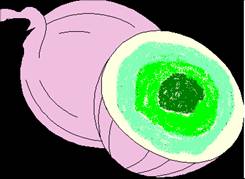
If we look
at the most external layer of the onion, that will refer to your
environmental preferences – for example, your preferences in terms of when
and where you prefer to study, if you prefer to get up early in the morning
or stay up late at night, if you need to eat and drink before, during or
after your study sessions, what kind of breaks you need, if you prefer to
sit, lie or stand, and things like that. If you peel off this layer, you’ll
find your preferences in terms of sensory modalities or ways of perceiving
information –whether you tend to be a visual, auditory or kinaesthetic
learner – or maybe a mixture of the three. Further inside the onion, you come
to your cognitive styles, your personal ways of processing information – for
instance, you may place yourself somewhere on the continuum between the two
extremes of being analytical, systematic, reflective, at one end, and being
global, intuitive, impulsive at the other end. And finally, when you get to
the core of the onion, you reach your personality traits, for instance, your
tendency to be an introvert rather than an extrovert, your preference for
individual rather than group work, the different degrees in which you can
cope with anxiety or can tolerate ambiguity, and so on. Obviously, as you
peel off the various layers of the onion, you progressively reach parts of
your learning style which are more and more stable and therefore less and
less easy to change.
|